

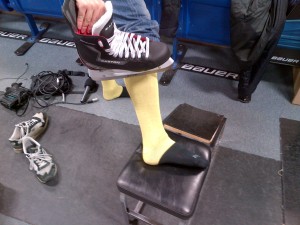
Here at Socks4Life we sell a wide variety of socks. We have dress socks, athletic socks, socks designed to help people diabetes maintain adequate blood flow, but we don’t have what I think are one of the coolest kind of socks. Kevlar. That’s right, bullet proof socks. Alright, maybe not bullet-proof, but cut proof at least. In one of those rare moments where a bunch of elements of my life come together(hockey, writing, socks) I’m going to delve into the science of the kevlar sock.
Kevlar socks first started showing up towards the end of my days of playing with any kind of real competitiveness and to a 16 year old they seemed like the most unnecessary and awesome thing to ever be knit. And I couldn’t wait to get a pair. To anyone not familiar with the sport of ice hockey, it’s a game played on a pair skates that sit on top of two eleven blades sharpened to cut into and glide on the ice. Naturally when you strap two ginsu knives to the bottom of your feet and play a full contact sport, sometimes things go wrong and instead of a blade hitting ice, you have a blade hitting a person. Hence the quest for a fabric that could stop a skate blade, but still allowed players to move enough to play the game.
The creation of a kevlar sock starts off with the fabrication of the kevlar fibers that give the composite fabric its strength. Kevlar is a polymer, meaning that it’s made up of long chains of a repeated chemical molecule, and unlike most other polymer’s the chemical structure of kevlar is unusually regular. The chemical chains in kevlar are long and straight enough that the chemical bonds it forms are like a reinforced scaffolding, almost crystalline if any of that high school chemistry is still rattling around. Once the kevlar is chemically formed it is forced through a spinneret and turned into a fiber that is woven into other fabrics to give them varying degrees of ballistic integrity, cutting integrity, and flame resistance. Some fabrics focus on the first point and become bullet proof vests and glass and are referred to as Kevlar 29, others focus on the cutting aspect and are called Kevlar 49. This fabric is then sewn into an otherwise normal looking sock shape and sent out into the ice rinks of the world to protect players’ tendons, veins, and hamstrings from the wayward skate blade.